Thought leadership · Series
The Seven-Layer Tokenomics Stack
Where AI costs are really decided, from the power plug to the prompt
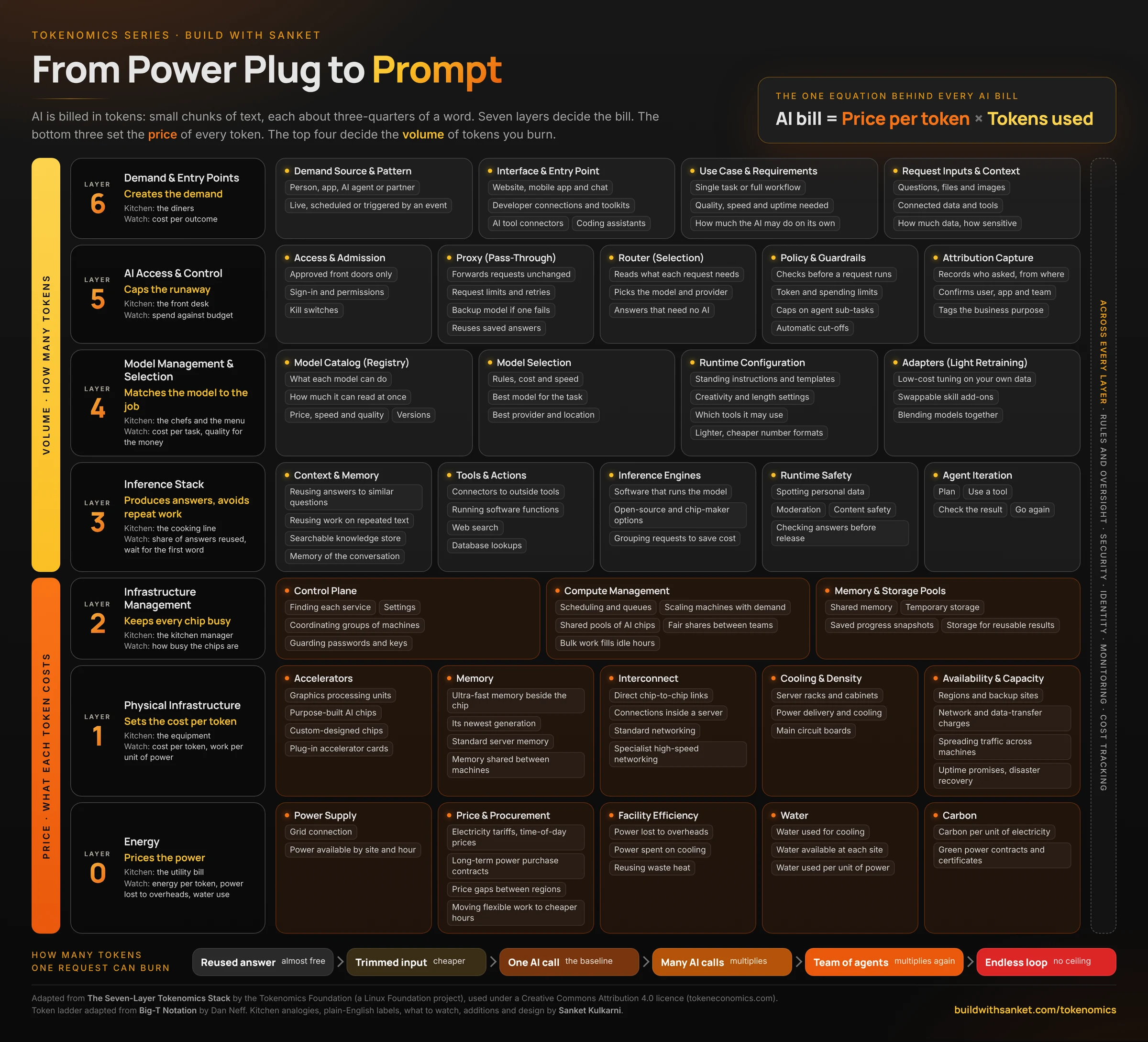
A plain-English guide to the economics of AI. Each chapter explains one part of the seven-layer stack, from energy and chips to models and demand.
32 chapters
From the power plug to the prompt
Layer 0: Energy
- 01
The Megawatts Nobody Can Plug In
4 November 2026 · 7 min read
- 02
Same Unit, Two and a Half Times the Price
5 November 2026 · 6 min read
- 03
The Bill Before the First Token
6 November 2026 · 6 min read
- 04
Water
How much water data centres use for cooling, measured as water usage effectiveness (WUE), and whether each site has enough of it
Coming up
- 05
Carbon
How clean the electricity is, and what green power contracts actually guarantee
Coming up
Layer 1: Physical Infrastructure
- 06
Accelerators
The specialised chips that run AI: graphics processing units (GPU), tensor processing units (TPU), neural processing units (NPU), application-specific integrated circuits (ASIC) and other custom-built chips
Coming up
- 07
Memory
The fast memory that sits next to AI chips, and why it is often the real bottleneck: high bandwidth memory (HBM, HBM4), dynamic random-access memory (DRAM) and Compute Express Link (CXL)
Coming up
- 08
Interconnect
The cables and links that connect chips and servers so they can work as one: NVIDIA links (NVLink, NVSwitch), Peripheral Component Interconnect Express (PCIe), Ethernet and InfiniBand
Coming up
- 09
Cooling and Density
Server racks, power delivery and cooling, and how tightly hardware can be packed together
Coming up
- 10
Availability and Capacity
Where computing capacity sits across regions and availability zones (AZs), the cost of moving data, spreading the load, uptime guarantees in service level agreements (SLA) and backup plans for disaster recovery (DR)
Coming up
Layer 2: Infrastructure Management
- 11
Control Plane
The software that sets up, coordinates and secures large groups of servers
Coming up
- 12
Compute Management
Scheduling work, scaling up and down with demand, sharing pools of graphics processing units (GPU) between teams and setting usage limits
Coming up
- 13
Memory and Storage Pools
Shared memory and storage for temporary data, saved progress and stored answers
Coming up
Layer 3: Inference Stack
- 14
Context and Memory
Reusing earlier answers, conversation history and company knowledge so the AI does not redo work, using a key-value cache (KV cache) and vector databases (vector DB)
Coming up
- 15
Tools and Actions
When AI calls other software through the Model Context Protocol (MCP), searches the web or looks up a database, and what each call costs
Coming up
- 16
Inference Engines
The software that actually runs a model and turns requests into answers, such as vLLM, TensorRT-LLM, SGLang and Text Generation Inference (TGI)
Coming up
- 17
Runtime Safety
Checking requests and answers for personally identifiable information (PII), harmful content and mistakes
Coming up
- 18
Agent Iteration
AI agents that plan, use tools, check results and try again, and how quickly that multiplies cost
Coming up
Layer 4: Model Management and Selection
- 19
Model Catalog (Registry)
Keeping track of available models: what each can do, how much text it can handle, its price, speed, quality and version
Coming up
- 20
Model Selection
Picking the right model, provider and region for each task, based on cost, speed and company policy
Coming up
- 21
Runtime Configuration
The standing instructions, settings and tool limits a model works with
Coming up
- 22
Adapters (Weight-Level)
Lightweight ways to tailor a model to a specific job without retraining it from scratch, such as low-rank adaptation (LoRA) and parameter-efficient fine-tuning (PEFT)
Coming up
Layer 5: AI Access and Control
- 23
Access and Admission
Who is allowed to use AI, how they prove who they are (authentication, authn) and what they may do (authorisation, authz), and the ability to switch it off
Coming up
- 24
Proxy (Pass-Through)
A gateway that passes requests to models, limits how often they are sent, retries failures and falls back to alternatives
Coming up
- 25
Router (Selection)
Sending each request to the right model, or answering it without a model at all, based on how hard it is
Coming up
- 26
Policy and Guardrails
Checks before a request runs: spending limits, token limits and caps on how far agents can branch out
Coming up
- 27
Attribution Capture
Recording which person, app, team and purpose each request came from, so costs can be traced
Coming up
Layer 6: Demand and Entry Points
- 28
Demand Source and Pattern
Who or what is asking (people, apps, agents or partners), and whether requests are live, scheduled or triggered by events
Coming up
- 29
Interface and Entry Point
The doors into AI: websites, mobile apps, chat, application programming interfaces (APIs), software development kits (SDKs), Model Context Protocol (MCP) clients and coding tools (IDE)
Coming up
- 30
Use Case and Requirements
The job to be done, the quality and speed it needs, and how much the AI may do on its own
Coming up
- 31
Request Inputs and Context
What goes into each request: prompts, files, images, connected data and tools, and how much and how sensitive it is
Coming up
This series builds on The Seven-Layer Tokenomics Stack by the Tokenomics Foundation, used under CC BY 4.0.